The Majestic Grey Owl
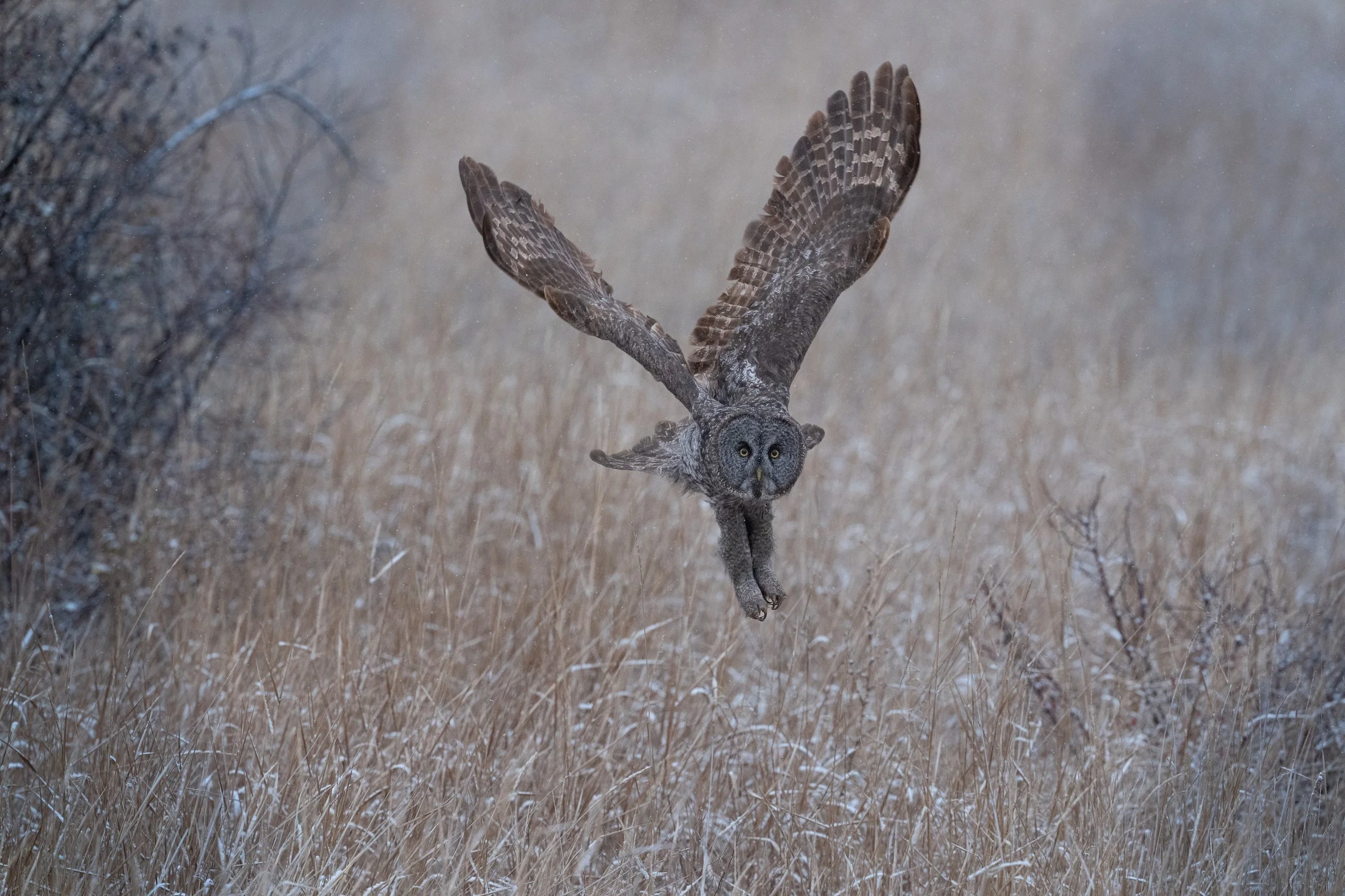
Grey Owl flying in silence
One of my earliest memories as a small boy was my passion for the great outdoors and anything to do with wildlife.
In my era, as a seven-year-old, the Wonderful World of Disney came on every Sunday at 6:00 pm. You had no idea what the topic or the story would be. It might be a cartoon. It might be a slice of Alice in Wonderland the movie, or if I were extremely lucky, a Nature Documentary about cougars, alligators, or bears. I couldn't care less; I just wanted to see something about wild animals in their natural habitats.
Another feature of Sunday night was the “Mutual of Omaha’s Wild Kingdom.” I loved this show. The host, Marlin Perkins, would always stay in the safety of the jeep or helicopter, and his assistant, Jim Fowler, would wrestle an alligator, or he would jump out of a jeep with dust flying to tag a rhinoceros.
For my underwater fix, I would tune into “The Undersea World of Jacques Cousteau” aboard the Calypso. Jacques would have on his trademark red beanie, and I got to discover what animals lived in our oceans.
Now that I have totally dated myself and most of you have no idea who I am talking about, what amazes me the most about the shows I grew up with is how they got live film footage of the action with the old camera gear. With our modern cameras and auto-eye tracking to keep us in focus as the action flies around us, they had to do it all manually—the hours they spent to get the shot. I always thought it would be so cool to be on-site as one of the camera guys, capturing all that stunning footage. (or be lucky enough to be Jim Fowler and be able to hang out of a helicopter to release the net on the gazelle)
My reality wasn’t a helicopter; it was the cab of my Dad’s GMC pickup. I distinctly remember my dad bought his first quarter of land 2 miles north and 4 miles west of town. (In the summer, I could ride to town on my bike.) It had a long, narrow driveway that wound its way back into the bush to the back end of the quarter, where there was an old barn and an old house. We were still living in town, but Dad would often take me with him in the evenings to check on the place. I always remember slowing down on the highway to make a left turn off the highway onto the driveway. I would get so excited because I knew that as soon as we started up the driveway, there was a good chance we would see an owl. He would usually be sitting on the big poplar tree on the first big right turn on the driveway. My Dad would always point him out and say, “There he is, waiting for us.” As we drove up the driveway, he would start to fly and lead us all the way back to the old homestead site. I would be standing on the seat (because I was too damn short to see over the dash) so I could get a better look at him flying around the corners up ahead.
Ever since I bought my first camera and long lens, I have been wanting to capture an image of one of my best childhood memories: an owl’s face flying against a majestic background.
This fall, I was fortunate to spend several days with this gorgeous Grey Owl. He would spend hours hopping from tree to fence post to shrub to stump to the ground in search of mice. He seemed unfazed by my presence, and he just went through his day in search of his next meal.
While I never saw him with a mouse, I did catch a picture of what I thought was a very small hawk (I think the mouse weighed more than what I later identified as a Northern Shrike flying with its meal). Although this picture is from a distance, I originally took it to clarify that I was seeing what I thought I was seeing.
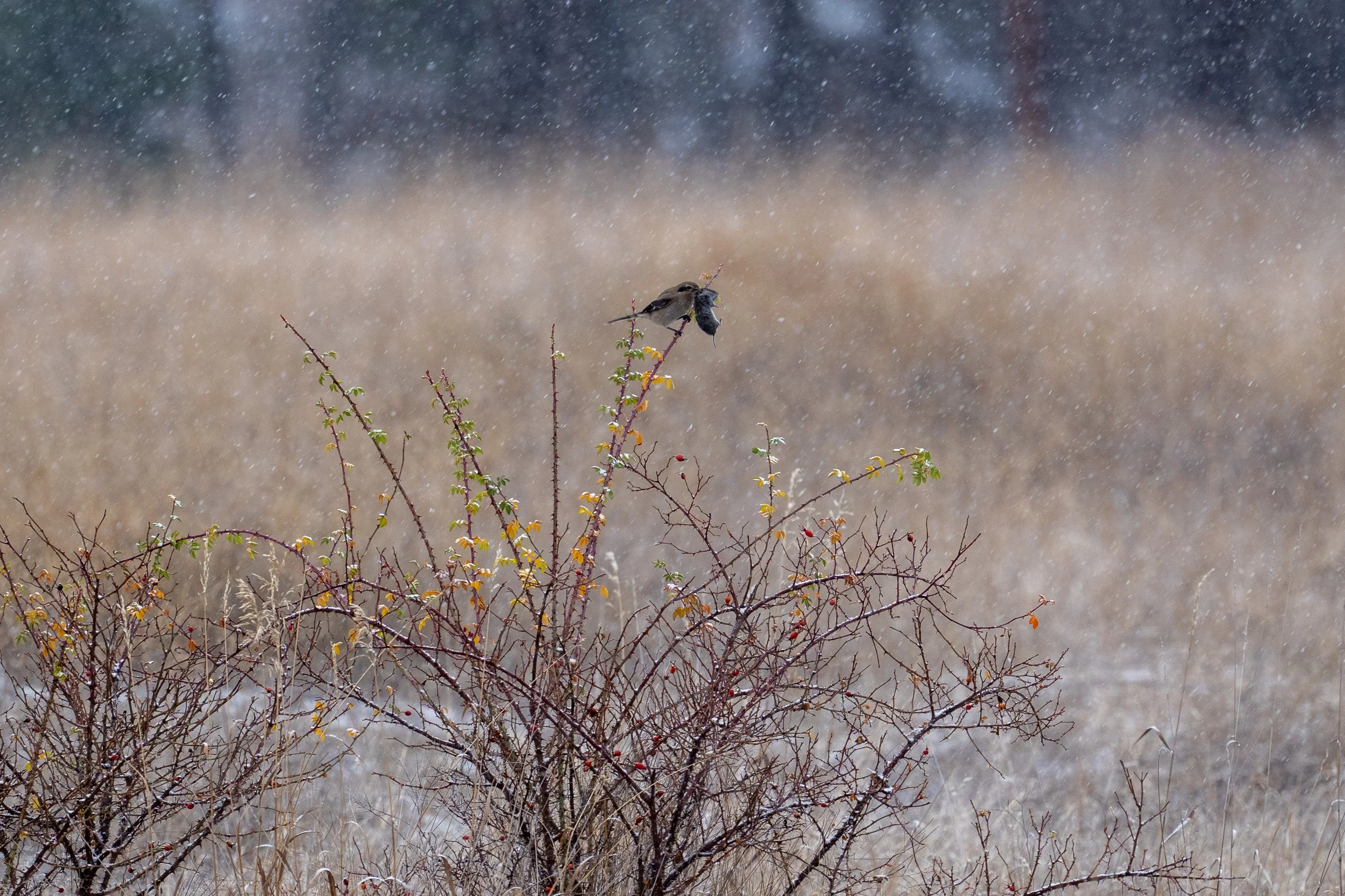
Northern Shrike with a mouse of equal size
As impressive as it is to see the owl’s outstretched wings in flight, it is even more amazing NOT to hear him at all. The owl’s silent flight is amazing. When you are used to hearing birds with distinctive flying sounds and can distinguish different birds just by hearing them fly, it is amazing to see a bird fly in silence.
Parrrots sound like the old one-cylinder John Deere tractor that you could hear 1 mile away. From an aerodynamic perspective, parrots are not sleek flyers. Hey, as a side note: You ever wonder why you always see pairs of parrots?... That’s why they call them parrots because they are always in pairs.
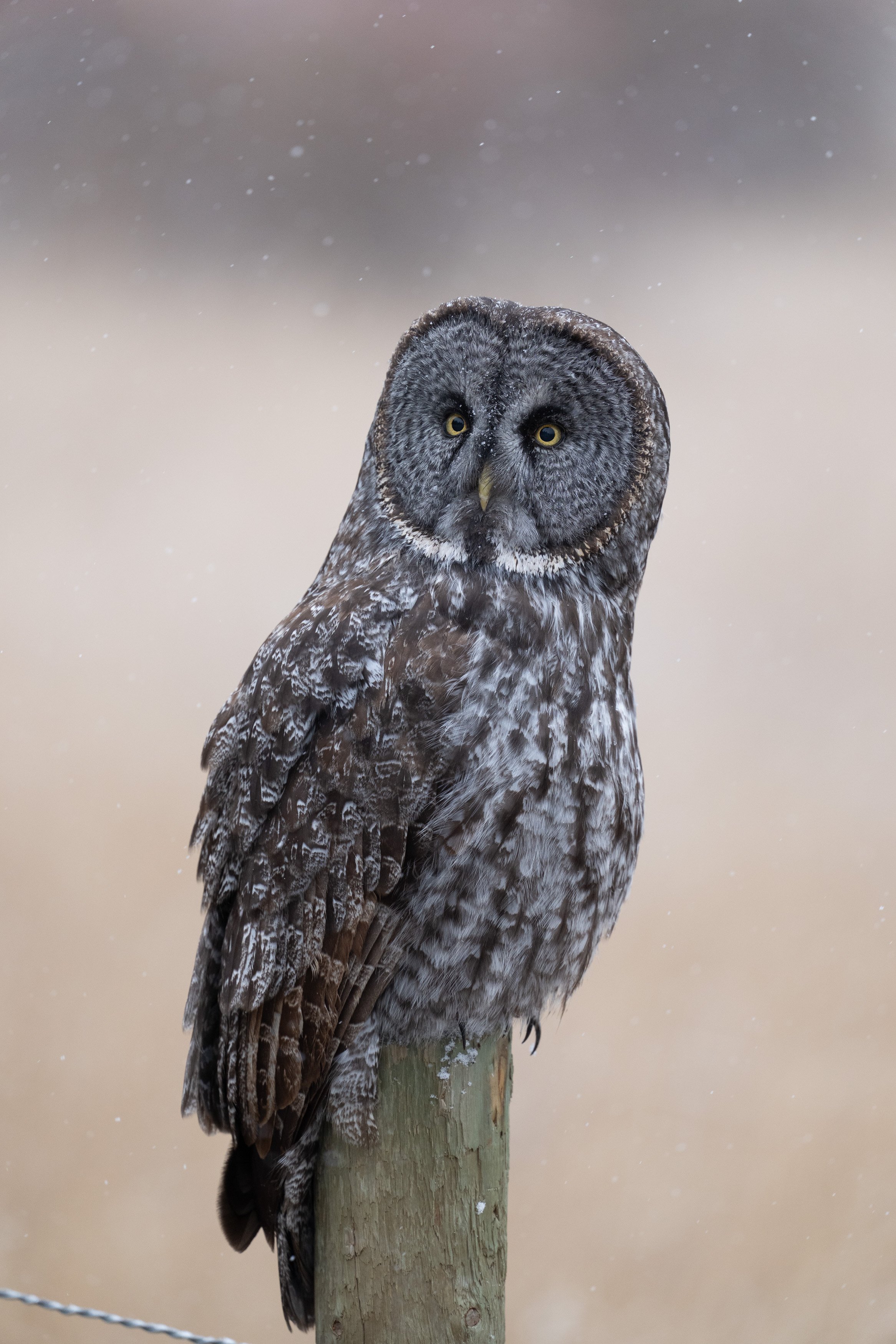
Grey Owl waiting with stillness
This is a stunning grey owl picture that Patti captured. You can see how fluffy the feathers are and how they billow. The downy, velvety feathers muffle the sound of the feathers rubbing together in flight during the wingbeat. This is one of the keys to their being silent flyers.
The colour of the feathers also creates a camouflage effect, allowing them to blend into their environment. In the wild, it is so easy to walk right past a perched owl. Some people have resorted to using infrared cameras to detect heat signatures because they blend in so well.
The next image of a grey owl proves how well they blend into their environments.
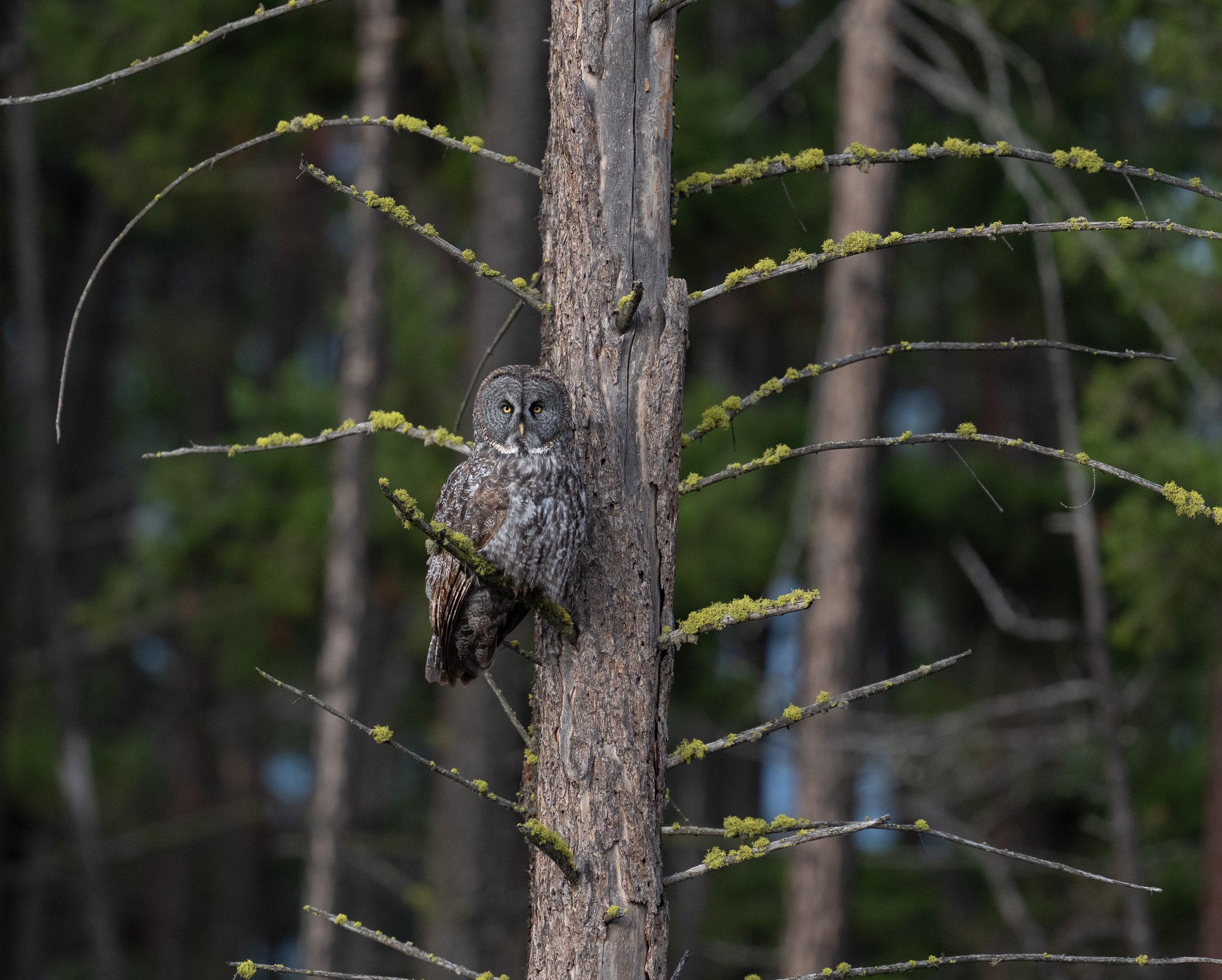
Grey Owl camouflaged against a tree
As for the round face and the piercing yellow and black eyes, you would think that vision is their key asset to finding prey, but you would be mistaken. (I made this mistake) The sense they rely on most to find their next meal is what you can’t see: their ears. The round face and feathers direct the sound to their ears. They can hear a mole moving under one foot of snow. They hear their prey as they fly over. This is also why being a stealth flyer aids them. The mouse or mole can’t hear them fly in, and because their wings emit no sound, they can hear the mole. So, it isn’t about who sees who first. It is more about who hears who first, who wins.